

Is it possible to buy a top-tier carbon wheelset for the price of a Western brand’s entry-level carbon set? This question was on my mind when I had the opportunity to review the Superteam S-All Carbon Ultra H2 D30-50 Disc wheelset. We put a flagship model from a Chinese manufacturer to the test—a wheelset that, on paper, is comparable in every respect to those used in the UCI WorldTour, but for a fraction of the price. Let’s see how it performs in practice!

Nowadays the wheelset is one of the most important parts of a road bike. However, it wasn’t the same 30 years ago. Factory-made wheelsets brought a revolution by exploiting the possibilities in composite rim design. Therefore, if you buy a new road bike less than €4,000-5,000, it’s almost certain that the biggest upgrade potential is buying a new wheelset – most of the time equipped with carbon rim.
It was the same in my case. I have a Van Rysel NCR CF, which came with an entry-level Mavic Aksium wheelset. It works fine because it’s a simple construction combined with a modern, wide rim, but the set weighs almost 2 kilograms. I had considered upgrade options, including higher-end alloy wheelsets and entry-level carbon sets from Western brands. Eventually, I had the opportunity to test a wheelset from Superteam.
Superteam: A Decade of Experience in the Carbon Wheel Market
Superteam is a Chinese manufacturer with about a decade of history. Specifically, they produce carbon rims that form the basis of their Superteam-branded wheelsets, selling about 30,000 sets per year, usually direct to customers. Furthermore, they also produce rims for other brands. Moreover, their wheels are made with both steel and own manufactured carbon spokes. Most hubs are their own design, although the S-All Carbon EVO II is built on DT Swiss hubs.
Superteam S-All Carbon Ultra H2: Top-Tier Tech at a Quarter of the Price
For this review, I got the flagship wheelset with Superteam hubs, equipped with almost all available technologies.
The rims are designed according to the latest aerodynamic research. The wavy inner edge, also used on Zipp NSW series, improves performance at various yaw angles, provides more stability in crosswinds, and increases structural stiffness while helping vibration damping. In addition, the shark-fin structures on the rim sides improve rigidity and reduce aerodynamic drag.
The rims are 30mm external and 23mm internal width, ideal for modern 28–32mm tires, and with a 50mm height they weigh just 430 grams.


The carbon spokes are made in-house, 3.2mm wide, and weigh 1.75 grams each, saving about 100 grams per wheelset compared to top steel spokes, and Titanium nipples save some additional grams. Another advantage of carbon spokes is that while steel spokes “stretch” under power, carbon doesn’t, meaning power transfer from hub to rim is more direct.
The hubs also feature advanced technology. Bearings are ceramic, standard cartridge type. The ratchet has 54 teeth, giving a direct pedaling feel, and according to the manufacturer, it is compatible with DT 350 ratchets. However, the use is debatable, though, since road versions of DT Swiss 180 hubs used in ProTour wheelsets only have 36-tooth ratchets.
Hubs for straight-pull spokes are compatible with Shimano HG or Sram XDR cassettes, centerlock or 6-bolt rotors, as well as thru-axle or quick-release options.


The wheels are laced with 21 spokes front and rear, in a 2:1 ratio. This means it helps balance the spoke tension differences caused by asymmetric hubs due to the cassette and brake rotor. On the front, the disc side has 14 spokes in two-cross pattern, while the other side has 7 radial.
Rims are tubeless-compatible factory equipped with tubeless tape, but valves are not included. The manufacturer quotes a weight of 1,290 grams for the set — right in the same league as the ENVE SES 4.5 Pro ridden by Pogačar—at about one-fourth of the price.
Performance On Paper vs. In Practice
At $1,099, everything seems perfect on paper. In practice, however, it’s different. Despite the higher-quality recent Chinese products, Western buyers can still be skeptical.
I think the rims are likely fine because Chinese manufacturers have mastered carbon production. The spokes are another story— in fact, most ProTour wheels still use steel spokes.
The main concern is hub machining and material quality; perhaps that’s why they give only a one-year warranty on hubs, but three years on rims and spokes. Ceramic bearings are attractive to many, yet I want to see how they perform over longer use—similarly with the freehub mechanism.
After unboxing
The wheelset arrived from China in three weeks, packed securely. Inside a smaller box, there was a user manual, a pair of spare spokes with nipples, and valve extenders. I think they look fantastic — in fact, after browsing through the manufacturer’s lineup, I’d say this is their coolest-looking model. The matte black finish with glossy black decals matches my bike perfectly.

Next came the mandatory weighing: the front wheel came in at 590 g, and the rear at 695 g, meaning we’re actually 5 grams under the claimed weight. Subsequently, I checked whether the cross-laced spokes were touching each other (naturally not) — this is something important with carbon spokes, since any rubbing can cause wear and potentially lead to failure (and even accidents).
An interesting detail: the carbon spokes have metal ends bonded to them, therefore the small metal parts you see near the rim are not nipples — don’t try to true the wheel there. The actual nipples are inside the rim and have hex heads.
After inspecting the wheels, I mounted a pair of Continental Grand Prix 5000 28 mm tires. These measured 29.5 mm wide on my Mavic rims, but 31 mm on the Superteams. A 60 mm valve is the perfect fit. The 54-tooth DT-style ratchet means business — indeed, even just rolling the bike around at home, it was obvious it’s going to sound serious when coasting.
During the Ride: Porsche-feel in the saddle
From the very first pedal strokes, I could feel the bike responding more easily and rolling incredibly smoothly. Therefore, by the end of the first ride, it was clear to me that this was a whole different level – it felt like the bike had been replaced entirely.

Some situations practically sell themselves: a small descent or a bit of tailwind and the wheels start spinning, bringing my speed effortlessly to around 40 km/h. Once rolling, it’s very easy to hold the pace. The wheels really start to “come alive” in the 35–40 km/h range, and after any acceleration, they allow smooth, fluid motion.
I tried some sprint starts as well, and the feel is impressively direct – every pedal stroke transfers immediately to the asphalt, and the bike jumps forward like a Porsche flooring it.
The weight advantage is also noticeable on climbs. On 8–10% gradients, I could feel that pedaling was easier, and even spinning the lightest gears felt lighter than I was used to.

Wind Behavior and Road Comfort
Wind behavior was a big question, because calm days are rare around here. To my surprise, the bike remained very manageable. Sure, side gusts require some extra effort from my core and a firmer grip on the bars, but it’s still completely within control.
I was initially concerned about comfort, since carbon spokes are less forgiving than steel. Fortunately, my experience has been wholly positive – road imperfections are absorbed better than with my alloy Mavic wheels. The rough surface vibrations are noticeable but never problematic.
Previously, I had been thinking about what to replace my 28mm GP5000 tires with once they wear out. On these rims, running 28mm tires at 5.2 bar front and 6 bar rear gives a perfect combination. Consequently, if I don’t test anything else, I’ll likely stick with this width and model going forward.

One interesting moment came with the front brake disc, which had a small figure-eight causing vibrations under hard braking. I lifted the front wheel and gently spun it to find the point needing correction. Amazingly, the wheel kept spinning and spinning, refusing to stop!
What If Something Goes Wrong?
Many riders worry about this, especially with Asian imports, since it’s not easy to drop into a local shop for warranty support. Therefore, I reached out to Superteam to ask about their protocol for typical issues and the associated statistics.

For example, if a rim cracks under warranty, the manufacturer will send a complete new wheel. Conversely, if the damage is caused by user error, they offer the option to purchase just the rim, which can then be re-laced at a local shop.
For spokes, the manufacturer provides one spare of each length, and additional ones can be obtained during the warranty period.
The hubs are the critical part, primarily the bearings and freewheel. During the warranty period, the manufacturer supplies replacement parts, and even after the model is discontinued, replacements are guaranteed for three more years.

I encountered a case where someone’s bearings failed after a year. They mentioned riding in rain and winter, storing the bike outdoors, so it’s not surprising. Even so, Superteam sent two full sets of replacement bearings, and the rider was very satisfied with their responsiveness.
Looking at the stats, nothing stands out: rim failure is under 1%, while spokes and hubs range between 1–2%. Importantly, this includes usage in non-ideal weather, and these numbers are on par with other reputable Asian and Western brands.
Verdict
Over the past month, I’ve ridden roughly 500 km on the Superteam H2 wheelset – on flats and climbs, in calm and windy conditions, and even once in a proper downpour. I’m not a light rider, and with my bike we’re close to the manufacturer’s specified weight limit, thus the wheels have been put through a serious test.
From every perspective, my experience has been positive. The wheelset performed excellently and delivered a lot of joy. Crucially, I didn’t encounter any figure-eights or other issues.

In fact, three of my friends also decided on the Classic Pro D28-45. One independently, one influenced by me, and the third after seeing another friend’s wheelset. I installed the last two myself, so after seeing two different sets, I can say the quality feels no worse than Western products.
One of the orders even required changing the delivery day via DPD, and the manufacturer promptly contacted me the next morning to ensure everything was okay – this is very reassuring attention to customers.
Who Should Consider Superteam Wheels?
In summary, if you feel your wheelset is the weakest link on your bike, it’s worth considering a Superteam set. For the price of a higher-end alloy set, you can get a Classic or Classic Pro. Alternatively, for the price of an entry-level Western carbon set, you can get a flagship S-All Carbon Ultra H2 D30-50. The experience and feel are on a completely different level compared to an alloy set.

A pro tip: store your original wheelset in the Superteam box. Firstly, if you change bikes later, it can be sold with the original set. Secondly, it provides a safety net during the warranty period, so you’re never left without wheels if something happens to the Superteam set.
The test will continue. I plan to update it next May, by which time I hope to have several thousand kilometers on the wheels. With the BIKEMAGHU discount code, you can purchase the S-All Carbon Ultra H2 wheelset with 5% off. Importantly, the price on the manufacturer’s website includes shipping, VAT, and customs duties (in EU, UK and US countries), meaning all you need to do is wait for your new wheels to arrive.
More information about Superteam S-All Carbon Ultra H2 wheelset click here.
Update
This time, when Superteam’s flagship wheelset arrived, I had no idea where this whole thing would end up. In the beginning, I had some mistrust, and after some rides I even checked the wheels for any wobbling or other problems.
Then, after many kilometers together, my trust grew more and more. Besides, my interest in other high-performance Chinese bike parts also started to grow. The result is a complete bike built with major components from Chinese brands, including this wheelset, which was moved to the project bike after 1600 km of testing.
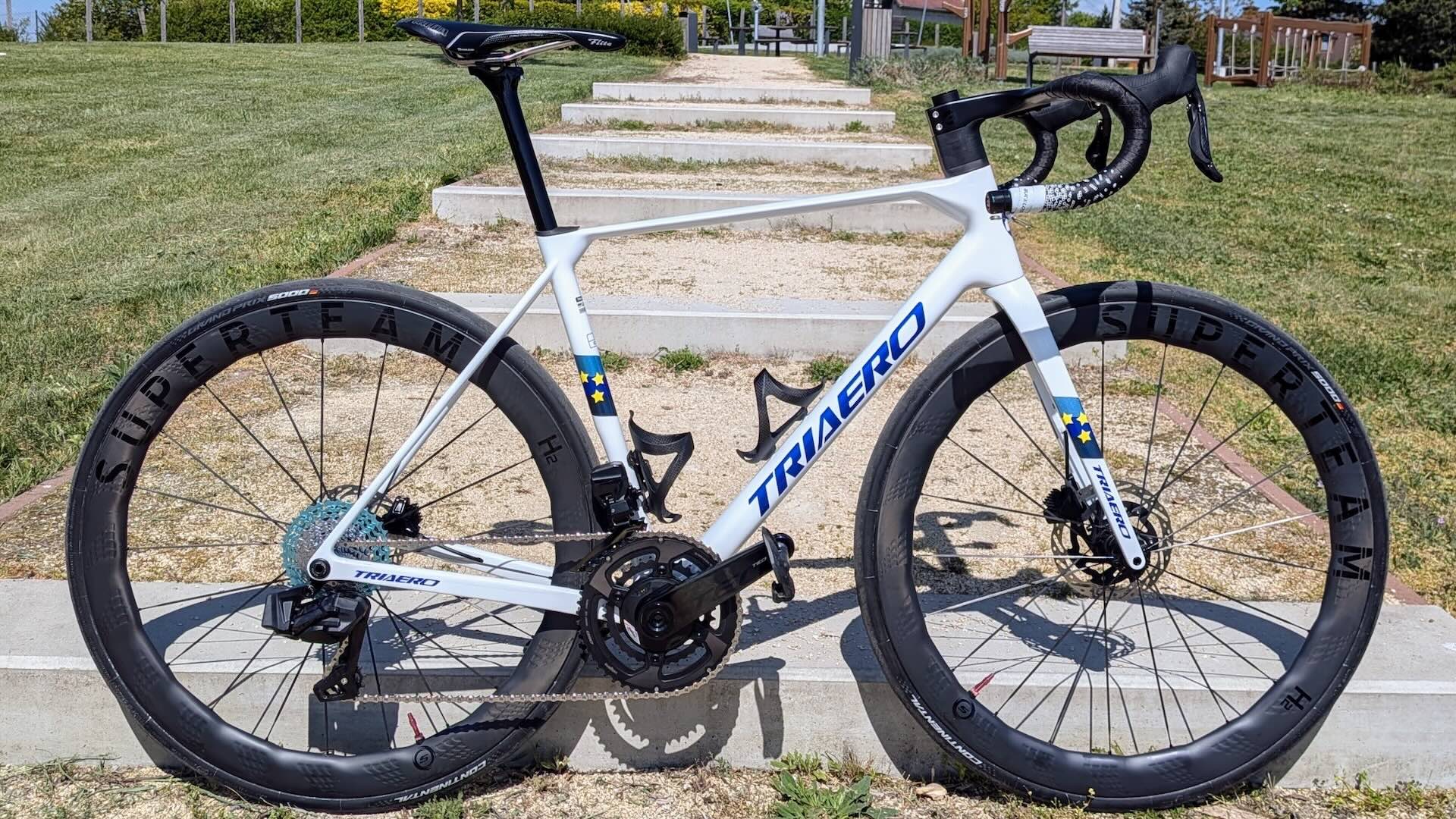
After 3300 km of use, the result is almost perfect. The bearings run beautifully, the spokes are tight and the ratchet also works well. Only the front wheel is slightly out of true, but 1–2 mm doesn’t really matter, especially considering that I’m quite a heavy rider.
I see carbon wheelsets as the most accepted products from the performance-oriented Chinese bike industry. Superteam’s products offer a high price-to-value ratio, and based on my long-term experience, I can recommend these wheels without hesitation.

